Introduction
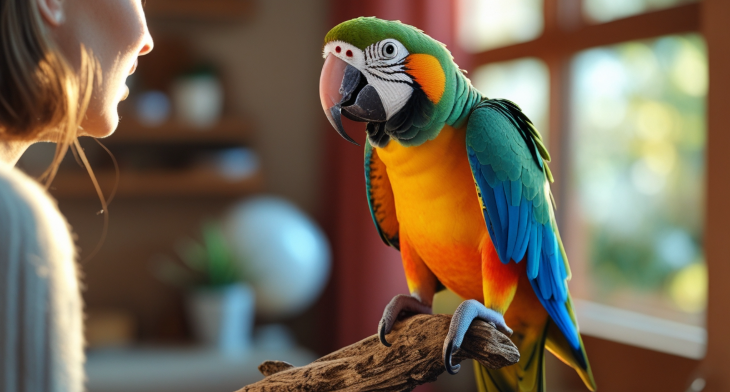
If you’ve ever heard a parrot clearly say a human word, it can be surprising and even a little funny. Some parrots don’t just repeat sounds—they copy voices, tone, and timing so well that it feels like they truly understand what they’re saying. Compared to most birds, parrots stand out for this ability.
Many bird owners notice that while other birds chirp or whistle, parrots actively try to copy human speech. This makes people wonder why parrots are so good at it and others aren’t.
The answer isn’t magic or training alone. It’s a mix of how parrots communicate, how they listen, and how they bond with humans. Parrots don’t copy words just to entertain—they do it as part of how they connect with their world.
What This Behavior Is About
Parrots copy sounds to communicate.
In the wild, parrots learn sounds from their flock. At home, humans become their flock, and human words become part of their shared language.
It’s social learning.
Main Reasons Parrots Copy Human Words Better Than Other Birds
Strong Social Nature
Parrots are highly social.
They rely on communication to stay connected with their group. Copying sounds helps them feel included and noticed.
Talking is bonding for them.
Flexible Vocal Skills
Parrots have advanced voice control.
They can shape sounds more easily than many other birds. This allows them to copy complex noises, including human speech.
Their voices are adaptable.
Learning Through Listening
Parrots learn by hearing repetition.
They pay close attention to sounds used around them daily. Words spoken often become familiar and meaningful.
Repetition builds memory.
Desire for Interaction
Parrots want responses.
When a parrot speaks and gets attention, laughter, or conversation, it encourages them to repeat those sounds.
Attention reinforces learning.
Long Memory and Awareness
Parrots remember sounds well.
They can store words for a long time and use them at specific moments, making their speech seem intentional.
Memory supports communication.
Is This Normal or Something Special?
It’s normal for parrots.
Not all parrots talk, but the ability itself is natural for the species. Some individuals are more vocal than others.
Talking depends on personality and environment.
What Parrot Owners Can Learn or Do
Speak naturally around them.
Using calm, consistent words helps parrots learn sounds more clearly. Patience and positive interaction matter more than training.
Connection encourages communication.
Common Myths vs Reality
Myth: Parrots understand language like humans
Reality: They copy sounds and context, not grammar.
Myth: Only trained parrots can talk
Reality: Many learn naturally at home.
Myth: Talking parrots are always noisy
Reality: They choose when to speak.
Myth: Parrots talk to show off
Reality: They talk to connect.
Frequently Asked Questions
Why doesn’t my parrot talk yet?
Some parrots take longer or prefer other sounds.
Do parrots know what words mean?
They associate words with situations.
Can other birds copy human speech?
Some can, but parrots do it best.
Conclusion
Parrots copy human words better than other birds because communication is central to who they are. Their social nature, flexible voices, strong memory, and desire to connect make human speech a natural part of their world. To a parrot, talking isn’t a trick—it’s a way to belong.
For owners, this ability is a reminder that parrots need interaction, attention, and understanding. When a parrot speaks, it’s not just repeating a sound. It’s reaching out, responding to its human flock, and sharing a moment of connection in its own unique way.