Mudskipper: The Fish That Walks on Land
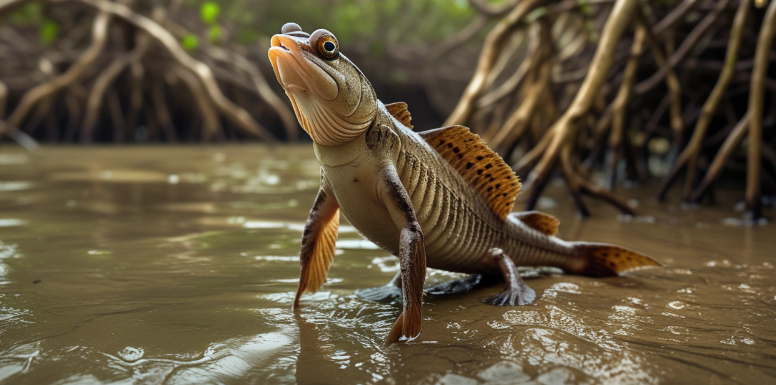
When most people think of fish, they imagine creatures swimming gracefully underwater. The mudskipper challenges that idea entirely. This remarkable fish spends much of its life out of water—walking, climbing, and even communicating on land. Found in muddy coastal areas, the mudskipper blurs the line between aquatic and land animals.
2. Where Mudskippers Live
Mudskippers inhabit intertidal zones, particularly mangrove forests and mudflats across Africa, Asia, and the Indo-Pacific region. These environments flood at high tide and dry during low tide.
Rather than hiding underwater, mudskippers roam exposed mud surfaces, taking advantage of reduced competition and fewer predators.
3. How Mudskippers “Walk” on Land
Although they don’t walk like mammals, mudskippers move impressively for fish.
- Use strong pectoral fins to push and pull forward
- Perform short hops and skips across mud
- Climb roots, rocks, and mangrove branches
- Balance using their tail
These movements help them escape predators and hunt food on land.
4. Breathing Outside Water
One of the mudskipper’s most extraordinary abilities is breathing air.
- Absorbs oxygen through moist skin
- Stores water in enlarged gill chambers
- Uses mouth and throat lining for gas exchange
As long as their skin remains damp, mudskippers can survive on land for long periods.
5. Table: Mudskipper vs Typical Fish
| Feature | Mudskipper | Typical Fish |
|---|---|---|
| Movement | Walks, hops, climbs | Swims only |
| Breathing | Skin, gills, mouth lining | Gills only |
| Habitat | Water and land | Water only |
| Eyes | Raised and movable | Fixed position |
| Survival Strategy | Amphibious lifestyle | Aquatic lifestyle |
6. Diet: Feeding Above and Below Water
Mudskippers are opportunistic feeders, eating both on land and underwater.
- Small insects
- Algae and plant matter
- Tiny crustaceans
- Worms and larvae
They often hunt during low tide, using raised eyes to spot prey on muddy surfaces.
7. Behavior and Communication
Mudskippers are territorial and surprisingly social.
- Raise dorsal fins to appear larger
- Head bobbing and fin waving displays
- Chasing intruders from territory
- Digging deep mud burrows for shelter and breeding
These behaviors help maintain order in crowded mudflat environments.
8. Reproduction in Muddy Homes
Mudskippers lay eggs inside air-filled burrows. Males actively transport air into the chamber to maintain oxygen levels, ensuring safe embryo development—even in oxygen-poor mud.
This reproductive strategy is rare among fish.
9. Why Mudskippers Fascinate Scientists
Mudskippers offer valuable insight into how ancient fish may have first adapted to land millions of years ago. Their anatomy and behavior help scientists understand the evolutionary transition from aquatic to land animals.
10. Conclusion: Nature’s Walking Wonder
The mudskipper is one of nature’s most remarkable creations. With its ability to walk, breathe air, and thrive on land, it challenges our definition of what a fish can be. More than a curiosity, the mudskipper symbolizes evolution, survival, and adaptability—a true walking wonder of the animal kingdom.