The Albatross: The Greatest Long-Distance Traveler of the Skies
Among all the birds that soar across Earth’s skies, the albatross stands alone in long-distance mastery. Known for traveling thousands of kilometers without landing, this majestic seabird symbolizes freedom and endurance. Spending most of its life above open oceans and returning to land only to breed, the albatross is one of nature’s most fascinating aerial travelers.
1. The Secret Behind Their Endless Flight
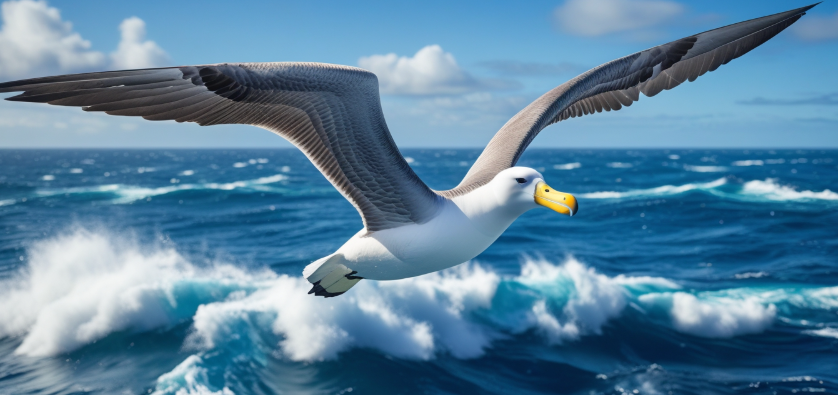
Albatrosses are not powerful flappers—they are masters of gliding. Their signature flying method, known as dynamic soaring, lets them travel huge distances with minimal effort.
How Dynamic Soaring Works
- Uses wind gradients above ocean waves
- Glides upward to gain speed
- Turns and descends toward the water
- Repeats the cycle with almost zero wing flapping
Thanks to this technique, an albatross can travel hundreds of kilometers a day while barely moving its wings.
2. Wings Built for Distance
The albatross possesses one of the longest wingspans of any bird species on Earth.
Physical Adaptations
- Wingspan reaching up to 11 feet
- Slim, aerodynamic wings ideal for gliding
- Strong shoulder joints for long open-wing glides
- Feathers shaped to reduce drag
- Lightweight body optimized for wind travel
3. Table: Albatross vs Other Large Birds
| Bird | Wingspan | Average Daily Travel | Flight Style |
|---|---|---|---|
| Albatross | Up to 11 ft | 500–800 km | Dynamic soaring |
| Eagle | 6–8 ft | 50–100 km | Thermal soaring |
| Pelican | 6–10 ft | 100–150 km | Gliding with flapping |
| Swan | 6–8 ft | 40–70 km | Heavy flapping |
4. A Life Spent at Sea
The albatross is among the most ocean-dependent birds in the world.
Lifestyle Characteristics
- Can remain airborne for months without landing
- Takes micro-naps while gliding
- Drinks seawater using salt-removal glands
- Feeds on squid, fish, and marine scraps
- Returns to the same islands every few years to breed
5. Navigation: How They Find Their Way
Despite traveling thousands of kilometers, albatrosses rarely lose direction. Their navigation skills are extraordinary.
Navigation Tools
- Highly sensitive sense of smell to detect food far away
- Reading wind patterns and ocean currents
- Use of Earth’s magnetic field for orientation
- Strong visual memory of coastlines
6. Why Their Long Flights Matter
Their long-distance abilities are not just impressive—they are essential for survival.
Reasons for Long-Distance Travel
- Finding scattered food sources
- Searching for mates during breeding years
- Avoiding storms and dangerous weather
- Following global wind routes for efficient travel
7. Conservation Concerns
Despite their remarkable abilities, albatross populations face serious threats.
Current Challenges
- Marine pollution
- Accidental capture in fishing lines
- Habitat loss on breeding islands
- Declining food availability in some regions
Conclusion: A True Master of the Skies
The albatross remains one of the most extraordinary birds ever observed. With unmatched endurance, refined navigation, and a body perfectly crafted for gliding, it is truly the world’s greatest long-distance traveler. Its story highlights the wonders of nature and the importance of protecting the species that make our planet so remarkable.