
Kingfisher
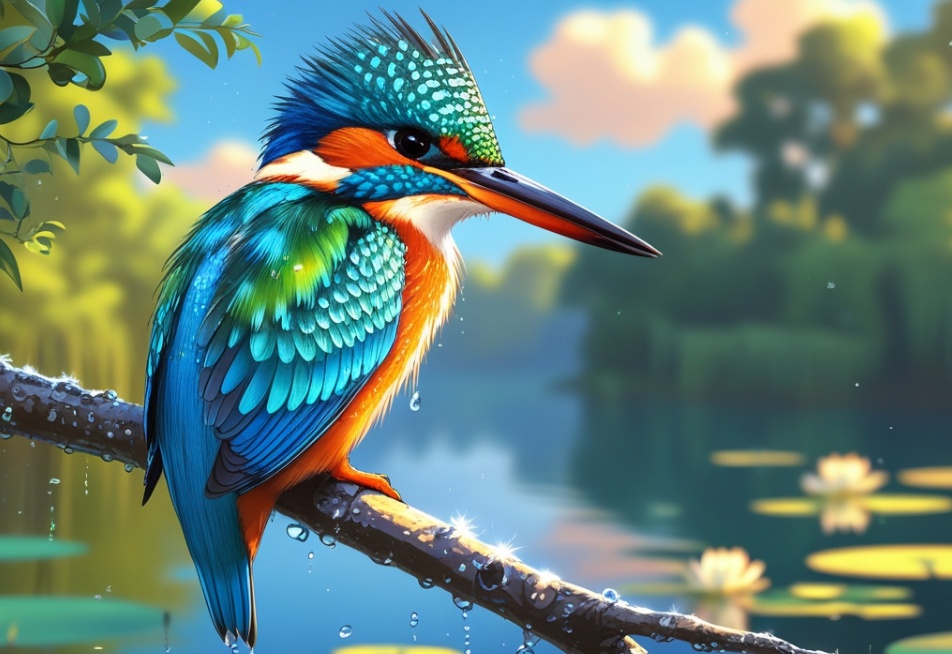
If you’ve ever walked near a quiet river or a small village pond early in the morning, you may have noticed a bright flash of blue passing by like a tiny streak of lightning. That flash is usually a kingfisher—one of the most eye-catching birds in the world. Its colors look almost unreal, as if someone painted it carefully with blue, orange, and white to make it stand out against the green water plants. Even though kingfishers are small, they have a powerful personality that commands attention.
Kingfishers are famous for their incredible fishing skills. They sit silently on a branch above the water, completely still, as if thinking deeply. Then, in a split second, they dive straight down and come out with a fish in their beak. The speed is so fast that many people miss the moment entirely. It’s almost like a magic trick—one moment the bird is sitting quietly, the next moment it rises from the water with its dinner. Their sharp eyesight allows them to judge distance perfectly, even through moving water, which is something humans cannot easily do.
What makes the kingfisher special is its preference for peaceful environments. They choose spots where water flows slowly, such as streams, rice fields, and lakes with plenty of small fish. They don’t like noisy or crowded places, which is why spotting a kingfisher often feels like discovering a hidden treasure. They usually live alone and are very territorial. If another kingfisher enters their area, a short chase often follows until one bird decides to leave. Despite their beauty, these birds are surprisingly bold and confident.
Their nests are quite different from those of other birds. Instead of building nests with sticks and leaves, kingfishers dig tunnels into riverbanks. Using their strong beaks, they create long burrows that end in a round chamber where the female lays her eggs. This underground nest keeps the chicks safe from predators and harsh weather. When the young birds hatch, both parents work tirelessly to feed them. You might see them making repeated trips to the water and back, carrying tiny fish for their hungry babies.
Kingfishers have a unique way of cleaning their beaks. After eating, they often rub their beaks against a branch several times, almost like wiping it with a cloth. This habit keeps their beaks sharp and ready for the next dive. They also spend a lot of time grooming their feathers. Because they dive into water so often, they must dry and maintain their feathers carefully to stay warm and light enough to fly quickly.
Their call is another interesting feature. Before you even see the bird, you may hear a sharp “ki-ki-ki” sound echoing near the water. The call is short but distinct, and once you learn it, you can easily tell when a kingfisher is nearby. Many birdwatchers say that hearing a kingfisher is just as satisfying as seeing one, because the sound often comes from hidden spots where the bird blends perfectly with the scenery.
Despite their beauty, kingfishers face several challenges. Pollution, shrinking water sources, and destruction of riverbanks have made it harder for them to find safe nesting places. Many small streams where kingfishers once lived have dried up or been replaced by concrete drains. When water becomes dirty or fish numbers drop, the kingfisher is usually among the first birds to disappear. This makes them an important indicator of environmental health—if the kingfisher is present, the water is usually clean and alive.
Yet, the kingfisher remains a symbol of hope. With clean water, natural surroundings, and a little protection, they return quickly to their old habitats. People in many villages still consider the sight of a kingfisher as a sign of good luck or a blessing for the day. Watching one dive gracefully into the water feels like witnessing a moment of natural perfection.
The kingfisher’s charm comes from its mix of elegance and strength. It may be small, but it rules its territory with confidence. It may be quiet, but when it moves, it moves like a flash of blue lightning. It reminds us that nature hides extraordinary beauty in ordinary places—sometimes you just need to look a little closer at the nearest pond or river to find it.