Introduction
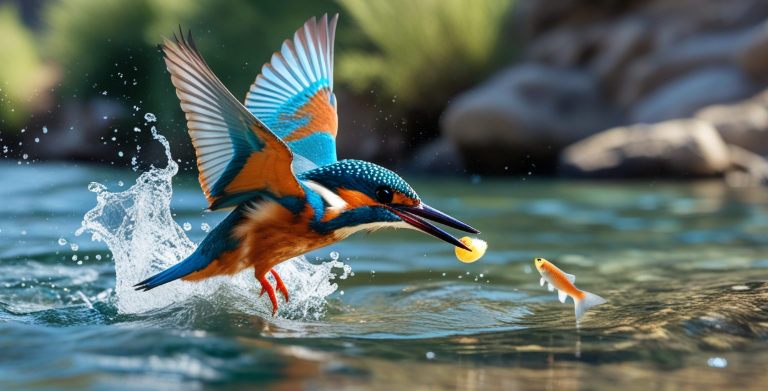
Watching a kingfisher hunt is one of those moments that makes people stop and stare. One second the bird is sitting perfectly still on a branch above the water. The next, it drops straight down like a stone, hitting the water at high speed. There’s barely a splash, and moments later it rises back up with a small fish in its beak.
For many bird lovers, this raises an obvious question. How does such a small bird dive so fast into water without getting hurt? Water may look soft, but at high speed it can be as hard as a solid surface.
Kingfishers repeat this dive many times a day without injury. This isn’t luck. Their bodies are specially shaped for this exact task. In this article, we’ll explain how kingfishers dive safely, what makes their hunting style so effective, and why this behavior is perfectly natural.
What This Diving Behavior Is About
Kingfishers are fish hunters. Their main job during the day is to spot fish from above and catch them quickly before the fish can react.
Diving straight into the water gives them an advantage. It’s fast, direct, and leaves very little time for the fish to escape. But to do this safely, kingfishers rely on a combination of body shape, timing, and control.
This diving method is not something they learn later in life. It’s a natural behavior that develops as they grow and practice hunting.
How Kingfishers Dive Without Getting Hurt
Streamlined Body Shape
Kingfishers have slim, compact bodies that reduce resistance when entering the water. Their shape allows them to cut through the surface smoothly instead of slamming into it.
The narrow profile helps them move from air to water with less impact. This reduces stress on their body and keeps the dive controlled rather than chaotic.
Even their posture during the dive is carefully aligned.
Sharp, Pointed Beak
The kingfisher’s beak plays a major role in safe diving. It is long, straight, and pointed like a spear.
When the bird hits the water, the beak enters first. This breaks the surface tension before the rest of the body follows. Instead of hitting the water flat, the bird slips in cleanly.
This reduces the shock that would otherwise occur during impact.
Strong Neck and Head Control
Kingfishers have strong neck muscles that help stabilize their head during the dive. This keeps the beak pointed straight and prevents sudden twisting.
Good head control is important because even a small misalignment could cause injury at high speed. The bird keeps its body stiff and focused until it reaches the fish.
Once underwater, the neck also helps snap the beak shut quickly.
Protective Eye Covering
When kingfishers dive, they briefly close a transparent inner eyelid. This protects their eyes from water pressure and debris while still allowing them to see.
This thin covering works like swimming goggles. It helps them keep their target in sight without damaging their eyes.
Clear vision underwater makes the dive more accurate and safer.
Perfect Timing and Precision
Kingfishers don’t dive randomly. They wait patiently and strike only when the timing is right.
By judging the fish’s position carefully, they avoid unnecessary dives. Fewer dives mean less risk overall.
Their accuracy also means they don’t need to dive too deep or too often, reducing physical strain.
How Water Entry Stays Gentle
Even though the dive looks dramatic, the actual entry into the water is surprisingly gentle. The bird’s narrow entry point and straight posture reduce splash and resistance.
This smooth entry helps prevent injury to wings and feathers. The wings are held close to the body during the dive and only open once the bird resurfaces.
Everything about the dive is designed to limit stress on the body.
Is This Normal or Something Rare?
This diving behavior is completely normal for kingfishers. It’s how they survive and feed themselves every day.
Not all birds dive this way. Some skim the surface, while others wade into shallow water. Kingfishers are specialists, built specifically for fast, direct dives.
So if you see a kingfisher diving repeatedly, there’s no cause for concern. That’s simply a healthy bird doing what it does best.
What Bird Lovers Can Learn From This
Kingfishers show how animals adapt perfectly to their environment. Every part of their body has a purpose, from beak shape to eye protection.
For people who enjoy watching birds, kingfishers are a great reminder to observe patiently. Their stillness before a dive is just as important as the dive itself.
They also teach us that what looks risky to humans can be completely natural and safe for animals designed for the task.
Common Myths vs Reality
Myth: Kingfishers hurt themselves when diving
Reality: Their bodies are designed to handle repeated dives safely.
Myth: The water cushions the bird naturally
Reality: The bird’s body shape and posture reduce impact, not the water itself.
Myth: Only large birds can dive safely
Reality: Size matters less than body design and technique.
Myth: Diving damages their feathers
Reality: Kingfisher feathers are well-suited for water contact and quick drying.
Frequently Asked Questions
Do kingfishers dive from very high places?
They usually dive from moderate heights to maintain control and accuracy.
Can young kingfishers dive safely?
Young birds practice gradually and improve with time and experience.
Do kingfishers dive in deep water only?
They often hunt in shallow or medium-depth water where fish are easier to catch.
Conclusion
Kingfishers dive into water without injury because their bodies are perfectly shaped for the task. A streamlined form, sharp beak, strong neck, and protective eye features all work together to make each dive safe and effective. What looks daring to us is simply a well-practiced natural skill.
Watching a kingfisher dive is a reminder of how precise and efficient nature can be. The bird isn’t taking risks—it’s following instincts that have worked for generations. Once you understand how they do it, those quick dives become even more impressive to watch.