
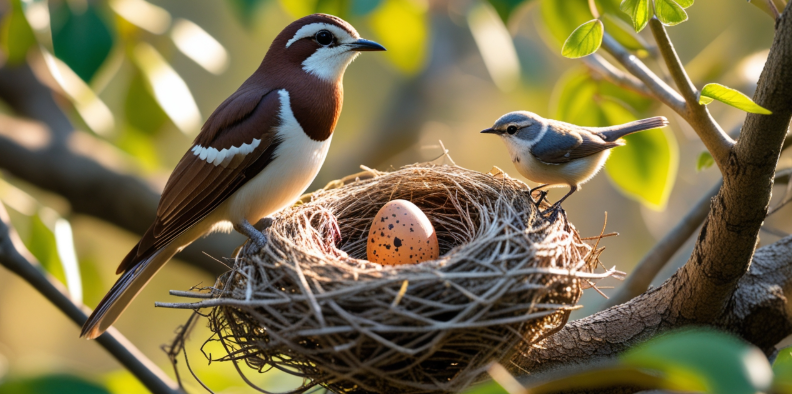
The Cuckoo: Nature’s Master of Brood Parasitism
Among all birds, the cuckoo is famous for a rare and fascinating behavior: laying its eggs in the nests of other birds. Instead of raising their own chicks, cuckoos depend on unsuspecting foster parents. This strategy, known as brood parasitism, helps cuckoos survive and spread their species with minimal effort and maximum efficiency.
2. Why Cuckoos Use Brood Parasitism
Raising chicks requires time, energy, and protection. Cuckoos avoid these responsibilities through a unique survival method.
Main Reasons:
- Energy Saving: They do not build nests or care for chicks.
- Higher Reproductive Success: A female can lay up to 20–25 eggs in different nests each season.
- Protection From Predators: Eggs spread across locations reduce the risk of losing all offspring.
- Evolutionary Advantage: Cuckoo chicks receive full care from foster parents.
This strategy increases the chance that at least some chicks survive every year.
3. How the Female Cuckoo Chooses a Nest
The female cuckoo does not lay eggs randomly. She carefully selects nests based on specific factors.
Key Selection Factors:
- The host bird must be smaller (easier for chick dominance).
- The nest must contain freshly laid eggs.
- The host species must have similar egg color patterns.
Cuckoos often target warblers, robins, pipits, and crows.
4. The Clever Laying Technique
Cuckoos are incredibly fast and strategic:
- The female monitors the nest for days.
- She waits for the host bird to leave.
- She swoops in, lays an egg in less than 10 seconds, and flies away.
- Sometimes, she removes one host egg so the change goes unnoticed.
The entire act is silent, quick, and almost undetectable.
5. Egg Imitation: Perfect Camouflage
One of the most amazing features of cuckoos is their ability to mimic the eggs of the host bird.
Examples:
- Blue eggs for robin nests
- Speckled eggs for warblers
- Grey-white eggs for pipits
This camouflage helps prevent the host from rejecting the foreign egg.
6. Behavior of a Cuckoo Chick
Once the chick hatches, its instinctive behavior ensures it receives all parental care.
Typical Cuckoo Chick Actions:
- Pushes out other eggs or chicks from the nest.
- Grows rapidly.
- Mimics intense begging calls.
- Demands more food than the host’s own chicks.
- Becomes larger than the foster parents within weeks.
The host birds unknowingly raise the cuckoo as their own.
7. Brood Parasitism Explained
| Feature | Explanation |
|---|---|
| Egg mimicry | Cuckoo matches host egg color & size |
| Rapid laying | Egg laid in under 10 seconds |
| Chick eviction behavior | Removes other eggs or chicks |
| Faster growth | Outcompetes foster siblings |
| Host tricking | Loud calls force extra feeding |
8. Why Host Birds Don’t Always Notice
Many host birds fail to recognize the foreign egg because:
- Mimicry is extremely accurate.
- Cuckoo eggs hatch faster.
- Hosts rely on instinct, not reasoning.
- Nest disturbance is rare and often overlooked.
Even when the cuckoo chick becomes much bigger, foster parents continue feeding it automatically.
9. Conclusion: A Genius Yet Controversial Strategy
The cuckoo’s method of laying eggs in others’ nests may seem unfair, but it is one of nature’s most remarkable survival strategies. Instead of investing time in childcare, cuckoos use intelligence, speed, and evolutionary adaptation to ensure their survival.
They remain a bird that fascinates scientists and bird lovers worldwide — a master of deception, survival, and adaptation. The cuckoo proves that in nature, survival comes in many forms, even in a tiny egg hidden in someone else’s nest.