Kingfisher Diving Tricks Explained
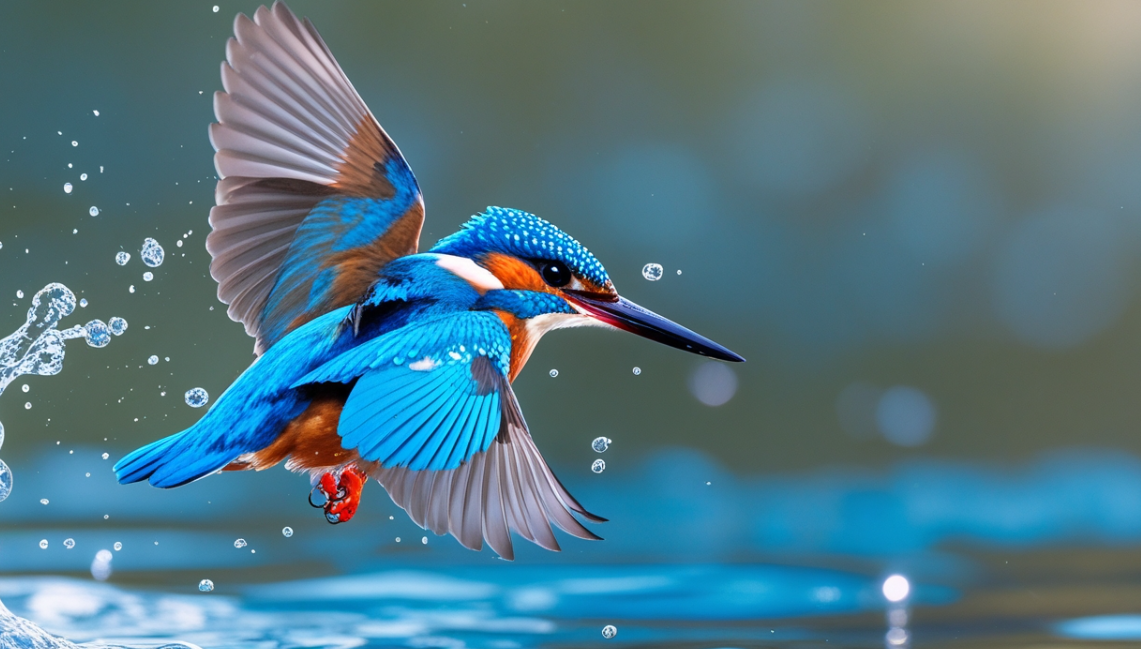
Among the most striking birds in the wild, the kingfisher stands out not only for its beauty but also for its extraordinary hunting abilities. Recognized by its brilliant blue-and-orange feathers, this small bird performs one of nature’s most precise fishing techniques—a rapid, streamlined dive straight into water. But how does such a small bird manage such advanced maneuvers? Understanding their diving behavior reveals the amazing natural engineering behind their body and instincts.
2. The Perfect Perch — Beginning of the Hunt
Every kingfisher hunt begins with choosing the ideal perch—usually a branch, stone, or fence placed above calm and clear water.
Key Perching Behaviors:
- Remains completely still to avoid alarming prey
- Watches from a high angle for better surface visibility
- Waits patiently until movement appears below
This approach allows the kingfisher to save energy while maximizing accuracy.
3. Superior Eyesight: Their Hidden Advantage
A kingfisher’s eyes are its most powerful tool. Unlike humans, these birds can judge distance accurately even through the distortion of water refraction.
Eye Adaptation Table:
| Adaptation | How It Helps |
|---|---|
| Dual-focusing lenses | Switches focus instantly from air to water |
| Nictitating membrane | Works like protective underwater goggles |
| Rapid depth calculation | Predicts fish movement with great precision |
These adaptations allow kingfishers to spot even tiny fish from several meters above the water surface.
4. The Famous Hovering Trick
If a perch doesn’t offer a clear enough view, kingfishers use a remarkable skill—hovering in midair like a helicopter.
Why Hovering Helps:
- Eliminates surface reflections that block visibility
- Allows the bird to stare straight down at prey
- Creates a perfect launch point for a precise dive
Only a small number of bird species can naturally hover, making this ability a rare aerial talent.
5. The Dive — Fast, Precise, and Silent
Once the target is locked, the kingfisher begins its iconic move—a fast, silent, and streamlined dive toward the water.
Diving Tricks Explained:
- Bullet-like posture: Wings tucked tight, body stretched into an arrow shape.
- High-speed descent: Uses gravity-assisted acceleration for minimal splash.
- Ideal angle: Usually around 45°, perfect for clean water entry.
This controlled dive allows the bird to surprise fish before they have time to react.
6. Special Beak Design for Cutting Water
The kingfisher’s long, pointed beak works like a natural blade, designed to slice into water without slowing down.
Beak Advantages:
- Reduces water resistance for smoother entry
- Protects the head during high-speed impact
- Helps grip slippery fish instantly
Its aerodynamic shape is a major reason the bird can dive repeatedly without injury.
7. Underwater Capture and Exit Strategy
After entering the water, the kingfisher uses rapid movements to secure its prey with precision.
Underwater Behavior Highlights:
- Grabs fish crosswise for a stronger grip
- Turns upward almost immediately after catching prey
- Breaks the surface with a sharp upward burst
- Flies back to a perch to swallow the fish safely
Amazingly, this entire sequence—from dive to capture—usually takes less than a second.
8. Conclusion: Nature’s Most Skilled Fisher
Kingfishers are far more than colorful birds—they are finely evolved hunters with extraordinary skills. Their diving tricks combine superior eyesight, aerodynamic body structure, and lightning-quick reactions. Understanding these behaviors gives us a deeper appreciation for how wildlife adapts to survive. So, next time you spot a kingfisher darting by a riverbank, remember that behind its beauty lies a master fisherman performing one of nature’s most incredible techniques.